How to Filter Variations by Attributes When Editing Products
Sometimes, when you have a lot of variations on your WooCommerce stores, navigating through them can be quite overwhelming.
For example, if you have 3 variation attributes with 10 values each, then you might have 3 * 3 * 10 = 90 variations! So, some of my clients do complain that the default WooCommerce variation interface is not very convenient in this specific case.
Can we do something about it?
In this tutorial, I will show you one of the ways to deal with it – and we will create a variation filter by attributes (an AJAX one).

How to Create Shared WooCommerce Attribute Stock
In this lesson, I would like to discuss how you can set up the WooCommerce attribute stock on your store. For example, you have multiple products with the color “blue” on your WooCommerce store. How to make all those products have the same stock?
Of course, there are multiple ways of achieving that.
For example, you can use the same SKU for these products with my Duplicate SKU Stock Sync plugin (don’t worry that by default, WooCommerce doesn’t allow duplicate SKUs, because my plugin allows you to use that). But in this particular tutorial, we will talk about using another way, specifically, the attribute stock.
Central Stock for WooCommerce
In this tutorial, I will show you how to configure central stock for WooCommerce using a plugin, but we will also take a look at the programmatic approach.
How to Disable Shipping Methods for Certain Products
Below, I will show you how to configure different shipping methods for different products in WooCommerce, so we can enable or disable a specific shipping method when a certain product is in the customer’s cart (or in a specific order).
We will dive into both programmatic and plugin approaches; more than that, I will show you how to do it not only for specific products, but also for products with a specific shipping class.
Auto-Select Variations Based on an Attribute in Product Archive Pages
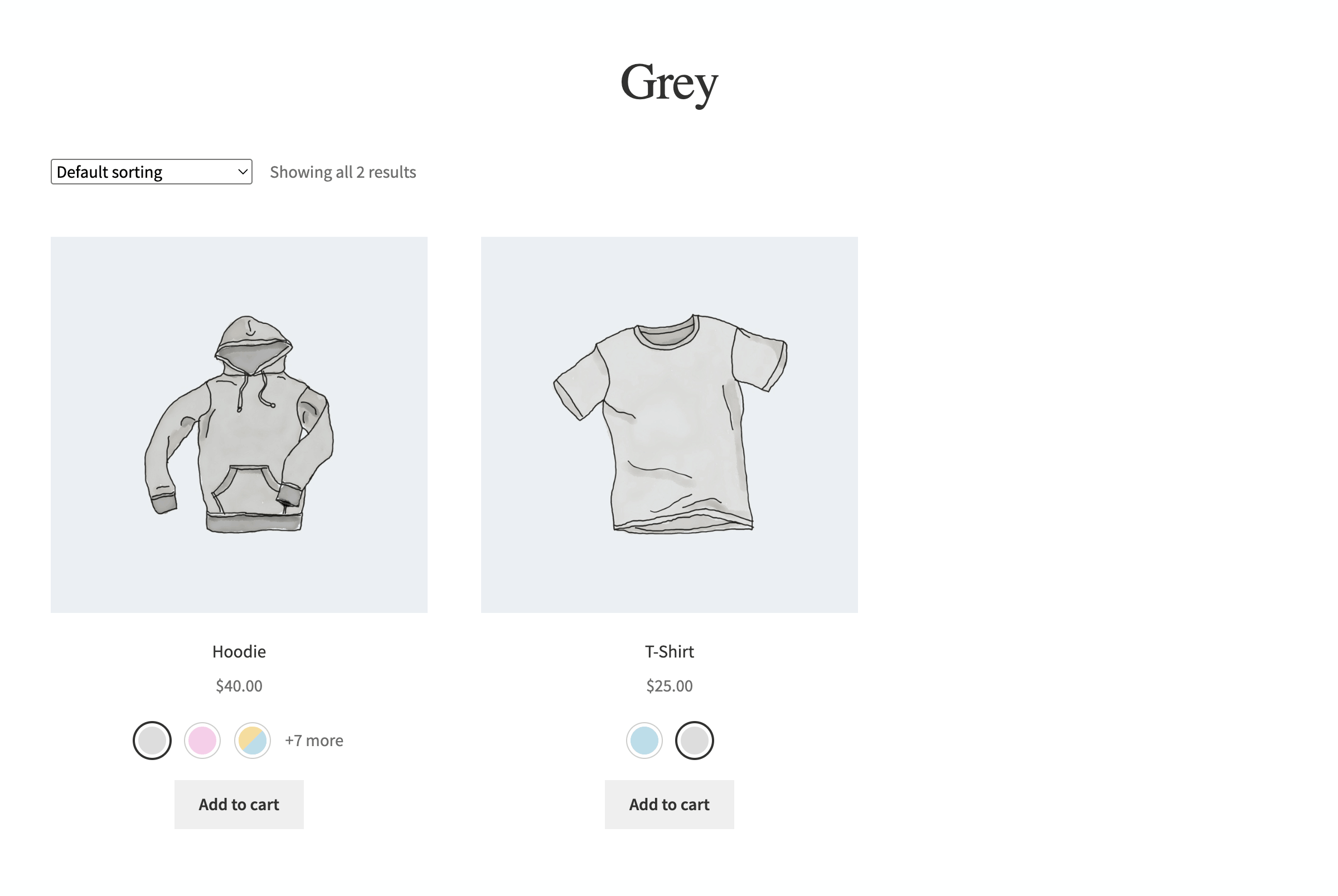
Below, on the screenshot, is a product archive page – it could be a product attribute page or a custom product category page. You may notice two things there:
- the “Color” attribute is displayed as a color swatch,
- the grey color is automatically selected when visiting the page, and more than that, an appropriate product image is also displayed.
Here you go:
Using WordPress Multisite for WooCommerce
When chatting with my customers, I keep getting the idea that people don’t always understand what a “WordPress Multisite network” is. Most of them think of it as a “multi-site” model for their store, like having completely separate stores (not necessarily on WooCommerce, by the way), each store with its own domain, database, etc.
Which is a completely wrong assumption!
Having a WordPress Multisite setup for your WooCommerce stores means:
- The stores will share the same server.
- The stores will share the same database.
- And what is most important – they share the same WordPress installation (basically, it means that if you sign in as a super administrator, you get access to every store within a single admin dashboard, or, if you sign in as a specific store administrator, you will get access only to that store and to all stores you’re added to).
Not sure whether you’re using WooCommerce Multisite? You can check it easily – if you have the following page in your WordPress admin dashboard, then it is a multisite network:

Once we get this main misunderstanding out of the way, let’s move to more practical stuff.
How to Show Variations as Single Products in WooCommerce
In this tutorial, I will show you an example of how you can configure your WooCommerce store to display variations as single products.
If you’re wondering how it may look on your store pages, below is a screenshot for you:
